

About this episode
Want to break into impact consulting? Dayoung Lee, Partner & Global Lead of Education to Employment Practice, shares exactly how.
Ready to love your Mondays? Buy ‘Work That’s Worth It’ now – Amazon, B&N, Bookshop.org OR, need more convincing? Get the first chapters FREE here.
SHARE THIS EPISODE


27 Jan 2026
SEASON 1, EPISODE 45
Show Notes
In this tactical conversation, she reveals Dalberg’s entry points (including straight out of college), what backgrounds succeed (hint: not just economics majors), and the real compensation story.
Dayoung explains why being equally comfortable in boardrooms and remote communities is the skill AI can’t replace, how Dalberg’s governance structure keeps impact sacrosanct, and which international offices are actively growing. If you’re exploring careers that combine challenging work, meaningful impact, and competitive pay—without forcing you to choose—this episode gives you the roadmap.
Keep Going:
💚 Got feedback on this episode? Email the host, Georgi Enthoven: info@georgienthoven.com
💚 Want more content? Get the full show notes & bonus content on YouTube: www.youtube.com/@GeorgiEnthoven
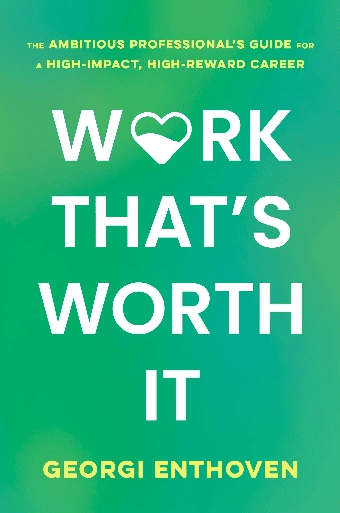
💚 Ready to begin transforming your career today? Start with Georgi’s bestselling book “Work That’s Worth It” – grab your FREE preview or BUY the full book today!
💚 Connect with Georgi Enthoven on Instagram (instagram.com/georgienthoven); LinkedIn (linkedin.com/company/georgienthoven)
Facebook (facebook.com/georgienthoven)
Website: www.georgienthoven.com
Transcription
Dayoung: [00:00:00] As part of being a good, being a good consultant, you have to. Be able to uncomfortable talking to the senior most stakeholder just as much as that child in the middle of the desert. And that is the unique value that we bring as a firm to be able to connect the dots and represent the kind of end stakeholder.
I feel like if you don’t get to do that, then you’re just in a conference circuit talking to the same group of people in an ivory tower with your numbers and theories. You’re never gonna get to a place where that’s gonna make a difference.
Georgi: Did you know the average person will work 90,000 hours in their lifetime?
What if you could use those hours to find fulfillment and become a disruptor for good? Welcome to the work That’s Worth It. Podcast. I’m Georgi Enthoven, and I’m here to demonstrate that an ambitious, meaningful, and rewarding career is not just a dream. It’s achievable. Each episode will dive [00:01:00] into conversations with global change makers who crack the code on combining income and impact.
If you’ve ever felt like you were torn between a paycheck and your purpose, or maybe you simply yearn for more purpose, you’re going to be exposed to the ambitious humans who have done it themselves ready to make your work worth it. Let’s get started.
The bridge from learning to earning can be challenging. Your major doesn’t necessarily determine your career path and getting exposure to hundreds of possible careers is impossible. At most, you can sprinkle in a variety of internships during your college years, but finding fulfillment takes a lot of trial and error, and that’s one of the reasons consulting early in your career can be so appealing.
It gives you more time and experience to really understand where you want to take your career. For that reason, I was so excited to connect with DaYoung Lee, a principal at Berg, who is based in [00:02:00] London, to hear about her career story and her experience at the firm. Here’s what makes this conversation especially valuable.
Dayoung doesn’t just share what the work is like. She gets specific about how Dalberg hires what they look for in candidates when they recruit, and what makes someone successful there. So if you are someone who wants challenging work, meaningful impact, and competitive pay, without having to choose between them, this episode is for you.
So let’s dive in. Welcome to the Work That’s Worth It. Podcast.
Dayoung: Thanks so much, Georgi, for having me. Really excited to be here.
Georgi: Yeah, it’s lovely to have you all the way from London. I am particularly excited to talk to you today because I hear many people bring up your company name and when I graduated from Berkeley, way back when, I really wanted to do good in the world and I couldn’t find something.
At the time in San Francisco that. Was doing good and seemed to meet my ambition [00:03:00] and have an income. Mm-hmm. And so I am excited to hear all about Berg and what you do and Yeah. For those who aren’t sure about your company mm-hmm. I was hoping that you could explain your mission and the type of work you do.
Dayoung: Yeah. Yeah, absolutely. And so I would say Georgie, that when I graduated college back in 2009 actually, and also in the Bay Area, I also did not necessarily feel like, and I wasn’t with Dalberg, that I had found this perfect combination of a job that was professionally super exciting and with, you know, doing work with a lot of purpose and impact.
But at the time, I think I was looking for an opportunity to learn. Really about anything, and I landed up at a company called the Parthenon Group. Now it’s a part of a bigger firm, Parthenon ey. And what I liked about that opportunity was they had a pretty large education practice and [00:04:00] having grown up in lots of different countries, because my dad was an expat, he worked for Hyundai, and so I grew up in Malaysia, in South Korea, in South Florida, Spain, and so forth, and experienced lots of different education systems.
From really large public education systems in the US where police were patrolling for 1600 kids in one school to a Christian sort of high school in South Korea to an international school in Spain and Malaysia and so forth. And so I had always kind of really appreciated the value of education systems and the ability.
That, you know, as a system, it can shape a child in a student’s life trajectory. Having experienced different systems myself, and so when I actually first entered the job market, I was, I think, attractive to me that I was at a place where I could learn fast and at the same time be exposed to challenges in the education space.[00:05:00]
Parthenon gave me those opportunities. But since then, I think as a primarily for-profit business, that’s not necessarily a social enterprise. I felt like after two years I’ve learned so much, but my projects really spanned from pet foods to, you know, a company that was producing monitor arms. So a lot of private equity due diligences where I felt like my core sort of analytical skillset, narrative telling skillsets were getting refined, but sort of hitting a little bit of a curve sort of plateauing while the problem statements I was working on, the education ones were really exciting, but because.
Maybe, you know, two thirds of the business wasn’t really in the education space. Not everything was exciting. And some of them quite boring to be honest. And so that’s where I was looking for alternatives. And I found Dalberg when I first graduated, Dalberg hadn’t been recruiting candidates fresh out of undergrad.
And now we are, and Dalberg has grown tremendously over the years. Uh, we used to be a much [00:06:00] smaller firm when I graduated, and since then we’ve grown. And so Dalberg is a social enterprise and our mission is to really help. Kind of people and planet people be the best versions of themselves and reach the full potential and really do good for the planet as well.
We are a for-profit business, but I think our structuring is, is quite creative in that our brand is owned by a trust that has the right to revoke the brand if we are not working on mission aligned projects. And so everything we do needs to be aligned with putting people on planet at the center. And so we hold that sacrosanct and that manifests in different ways that we do business, including having something like a values-based sort of selection committee where if we feel like a particular project does not align with our mission and values, anyone in the firm can raise that to that committee.
[00:07:00] And we have a quick process for getting views around the table to advise the kind of senior leadership driving those engagements at the very early stages of business development all the way through any time a project is underway to be able to actually withdraw from those engagements or mitigate those risks.
In different ways, and so I think we’re a consulting firm, but a hundred percent, I think we are the largest consulting firm that a hundred percent focuses on social and environmental issues, and we take that impact lens to everything we do. Really enabled by this kind of governance structure that I feel like is quite unique.
Georgi: That’s so exciting. I work with a lot of people who are Gen Z and obviously purpose and values is something that we know is important to this generation, and Gen Z will be, I believe, 30% of the workforce. Pretty soon, and it’s wonderful to have an opportunity where you can come into a firm that [00:08:00] actually is values aligned and cares about the projects that they work on.
So you can take that off your list and you can focus on the learning and the growth, which was so valuable to you in the early part of your career. Can you walk us through a typical project and what does impact consulting actually look like day to day?
Dayoung: Yeah. Yeah. So I would say a lot of our engagements are strategy engagements, so helping organizations, whether it’s nonprofits or foundations and philanthropies, really think about what should they be doing.
So looking back at the last five years to, let’s say, figure out what’s been working well, what’s not been working well, and then looking at. A market analysis of what’s actually changing in terms of the big trends and who are the other peers or competitors in that space, and what is your unique value add.
So distilling that now, perhaps not too different from a business strategy, but here instead of maximizing profits where the equations, you know, [00:09:00] revenues minus cost equals profits slightly more straightforward, I think, although, of course a lot of thinking and innovation needs to be required as well to how do you maximize for impact.
And so having a clear theory of impact or theory of change that guides the organization into, given what we’re really good at, what is the problem that’s kind of rapidly changing perhaps, and where the need is and what others are doing. What role do we uniquely want to play to supercharge our impact footprint over the next five years, for example?
Or for a foundation to say, okay, uh, I have this amount of resources to give. What is my theory of giving? What can I craft as my portfolio and the theory of impact and therefore what are the pillars of investment? What are the areas that we should double down on versus actually divest from? What kinds of partnerships should we form?
What are therefore, you know, pipeline of really exciting organizations to back and how do we give [00:10:00] effectively, efficiently, more impactfully, for example? So a lot of our work is kind of core strategy work. I would say that’s a bread and butter for us. And increasingly, we’re also doing a lot of work in measuring and kind of really improving the impact itself.
So we have a practice area called monitoring, evaluation learning, but unlike more of a assessment technical organization, a lot of it, what we’re doing is more strategic. MEL or marketing value learning to at the organizational level in a more holistic way, even if it’s at a program level, figure out what’s working and what’s not to have the most impact.
And how might you tweak your program or your portfolio of giving or your organizational strategy to make greater impact, whether it’s assessment of student learning outcomes and combining that with really data around thinking about. The scalability of the model, the cost effectiveness of the [00:11:00] intervention.
And so it’s not about how much money or how much impact you’re making, but actually relative to how much money and resources are you spending and therefore is the cost per unit of impact reasonable and can you minimize that right?
Georgi: Okay. And I imagine each project measures success differently depending on what a client would be coming to you for.
Dayoung: Yeah, yeah, definitely. I think we measure, and this is actually a big internal initiative that one of my colleagues is driving, how do we measure at Dalberg our own impact? Better. And you know, currently we of course, because we work through different organizations and teams and leaders, rather than having directly, you know, impact on our own, although we’re increasingly doing some of that work as well.
So I’m happy to share a bit more about that type of work. But we ask our clients actually, what impact have we had on your work? And to what extent do you feel like, you know, it actually moved the needle? We added value in a different way and you know, basically, [00:12:00] would you work with us again and so forth.
So a big part of how we measure our impact is how our clients sees us as the type of work that we’ve been doing, adding value to supercharge their work. And the other way that we think about impact is of course, on our teams and people and how they felt like their experience was and what impact do they feel like they’ve had.
So we listen to our teams quite a lot and make sure that they’re experiencing the impact that they’ve had on their projects and their projects have had on our clients and our silent clients often, who are, you know, the children from low income communities and the young people, for example, that we’re serving.
Yeah, and then, and we’re now getting more, I guess, robust in tracking that actual end beneficiary, if you will, or participant or user impact as well through things like basically accounting for how many people did this project cover and what are the impact statements and backtracking kind of what happened to a, [00:13:00] a little selection of postmortem of of projects that are representative of our portfolio and diving a little bit deeper into the types of impact each had and so on as well.
Georgi: Yeah, so exciting. Do you have a example of a project you could share that you’re particularly proud of? I’m not sure if you can actually share a client name, but if you can’t, great. And if not, just even the topic and why you’re proud of it.
Dayoung: Yeah, yeah, yeah. And so one really memorable project was actually my first project at Dalver when I was a consultant.
Where basically the queen of Qatar, who was the ambassador for Millennium Development Goals at the time, so this was before the Sustainable Development Goals era, aiming for Universal primary Education and was excited to put significant of her own resources behind this initiative that is now. Called Educate Child Initiative, and Dalberg was supporting the organization in developing the early sort of blueprint for what [00:14:00] should this initiative look like, which countries should be prioritized given the need and the size of the problem.
So total number of out school children, for example, in all the different drivers for why children are still out of school in the primary school going age, whether it’s conflict or gender-based discrimination. Lack of financial resources and so on, and then mapping that to what we call the supply side or the ecosystem of great organizations that the funding could support to supercharge their work to meet those needs.
And that project I think was really special because we got to not only put the best kind of analytical brains to do that mapping of. What are the countries and within those countries, what are the most effective models? Looking at the unit economics of different interventions, but actually then help develop the early first round of pipeline of organizations that this [00:15:00] initiative could invest behind, to then mobilize further funding around and further excitement.
And that really as a consultant, I was working on the India team. By that time there were four teams, Bangladesh, India, in Kenya, and part of our India work. I got to really meet tons of incredible education organizations working in the most remote, sort of hardest to serve areas. And to say, okay, from my desk research and all these numbers and the impact annual reports, and these seem to be a short list of organizations that are doing great work, actually getting on the ground, going to the run of K, which is, you know, in the middle of nowhere, a state called Gura that has these salt mines and where half of the year it’s a farming community and half of the year they do salt mines and it’s really, really tough.
Kind of desert, barren area that, and you have to rebuild schools every year to get teachers who are well qualified to get out of there in the middle of nowhere [00:16:00] to serve children with such bare bones infrastructure. I think it was just so. Inspiring to see the dedication of some of the leaders who were running educational organizations for these children in such circumstances, and just meeting the kids who had like such amazing ambitions to be policemen, Bollywood stars or doctors in the communities, and yet their circumstances.
So limited and the only sort of way out for them to not become a salt minor, which every parent was like, the only thing I don’t want my child to be is what I’m doing right now. It’s, you know, such dangerous and kind of low paying work and so forth and vulnerable work was actually education. And so I think that project gave me sort of the bird’s eye view of how does an ambition for like a ward leader on a millennium development goal, you know, global goal, problem statement, and significant financial resources.
Translate down through good analytical thinking to a concrete set of [00:17:00] organizations, and then the further due diligence process, which I was very used to from like private equity due diligences, but then to be able to go all far corners of India to. Visit, you know, various models and see the impact on the ground to then be able to craft a few organizations and projects that are really, really worth and deserves the most.
Funding that could make a big difference to children. To take it back to the Queen and the initiative for the organization, I think was really, yeah, it was really what made me. Wanna continue my journey at Dalberg. And so yeah, that, that first project, I think still stays with me as one of the most memorable.
Georgi: So inspiring and I love that you are able to share that you do do this bird’s eye work, but you actually can meet the people that you are having an impact on. ’cause often people think of consulting as you’re, you never sort of actually get to interact with the person that you’re working to help.
Dayoung: [00:18:00] Yeah.
Georgi: And so I think that’s so exciting. And I also know from what you’ve shared with us already, that. Your early life was an adventure given what your father did. Mm-hmm. And you’ve been able to keep those adventures folded into your work and lived in different places and been on projects in different parts of the world.
Mm-hmm. And so that must be an exciting aspect for you as well.
Dayoung: Yeah, yeah. No, absolutely. And I think. What I love about my work is the ability to connect with some of the most senior stakeholders and decision makers who get to choose what they do with incredible amounts of influencer resources. But then all the way down to that child in the middle of round of Koch, in the Salt Minds and ask her, we know what she wants to be and why is this, you know, organization, is this school mean so much to her.
To be able to be in the boardrooms as confidently as, you know, a kind of makeshift school and to be feeling like my [00:19:00] work, I can see what I’m doing, actually make a difference to a child’s life for me is, is, is really critical. And I feel like if I didn’t have. Such opportunities, especially in my younger days, I would probably be a lot more cynical about starting to like run the Excel models and so forth.
And I think increasingly AI could do so much of the secondary research, even the data analysis. But actually there isn’t a lot of data around, you know, these children’s stories and their lived experiences and the hardships that they go through. And so I think nowadays the value of actually learning from the ground and the live realities of the folks that we are trying to serve.
Is all the more important. And that is, I think, the uniquely human side of the consulting work and the analytical toolkit that I think is now even more valuable as a lot of what I used to do is like sift through reports. And so synthesize large amounts of data like that could be done in a few seconds, probably by, you know, AI quicker, right?[00:20:00]
But those situations with the small holder farmers, with the children, you know, in the middle of the desert and so forth, I think you just cannot replace. Without those insights, I think you also can be really blindsided about wrong assumptions you have and those kinds of data are far scarcer and so you also get really biased information.
Yeah. And so I think that was a critical part of why I chose to do the type work I do. And I think for our young people today, even more valuable experience and part of analytical, I think value add.
Georgi: Well, I would love to talk a little bit about how you get hired and thrive at Berg. Yeah. So what are the main entry points that somebody can come in?
Dayoung: Sure. So our website, I think has uh, gotten a lot better over time, and all of our openings are pretty clearly posted on the dalberg HR website. So I would direct candidates interested in openings at Dalberg to go there, and we run our recruitment as a region. So the North [00:21:00] Americas or the Americas, sorry, north America and South America Americas is a region.
Europe, Asia Pacific, and Africas and so on. And each of the recruitment teams have a slight, differently, different approach. For example, you know, a set of universities and kind of higher education institutions. That they may participate in, like actually going on campus to put on recruiting events and so forth to share what Dalberg does and so forth.
And in India though, I think a few years ago we actually revisited that approach and felt like that was getting two sort of limited pool of similar candidates. And so we started to rely more on actually getting a wider set of applications from different kind of educational institutions. And spending more time on actually getting to know the candidate through a little bit of pre-work.
So we ask people to write an essay, for example, and then, you know, basically come in for, for interviews. And [00:22:00] sometimes, and we’re still experimenting with it, like how much and to what extent do we use AI to screen some of the cvs and so on. But I think because we also ask for project kind of write up and so forth, we look for people who, who both have the.
Kind of consulting abstract problem solving rigor, but has a deep passion for the impact work that we do. Because, you know, quickly we do, I think, pay pretty well relative to, you know, our industry. But for the type of talent that we get, they could easily get a private sector job that may be much higher paying, especially as folks get more senior.
Right? And so, unless I think. You are doing this work because you love it and you can’t wait to, you know, read more about this. This is like your fun weekend reading is about the project that you’re working on and, and so on. Uh, uh, retention could be, could be a challenge. And of course, it’s great that they get a, I think, training ground from [00:23:00] Dalberg to think about even whatever issue they’re working on, including pet food production and monitor arms, whatever, with a social environmental.
Lens and an impact lens. I think that’s also an important part of Dahlberg own theory of change that our people and going through almost this like bootcamp of how to think about every issue with an impact lens. And solve things in a way that’s beneficial for the planet and people is a good thing. But we know, obviously want people to also continue to thrive and grow in our firm.
And so, so those are some of the characteristics that yeah, we look for.
Georgi: Okay. So out of college, you’ve mentioned that you are hiring people directly out of college now, right? As also like as an MBA, a second point, or, uh, is it? Yeah,
Dayoung: you go
Georgi: to those two
Dayoung: business schools as well. And we do, of course, also hire laterally at all levels.
And we look for talent that bring different skill sets. And so consulting path is, you know, the [00:24:00] majority of our staff, but we also have, uh, now increasing and larger communications team. I think we don’t talk about our work enough and how do we amplify kind of the insights and the perspectives unlike kind of our, you know, for-profit consulting peers, not that we are not-for-profit, but the traditional consulting houses whose work, a lot of the clients are confidential and the data they’re dealing with, the insights are, you know, IP wall private.
We owned many of our clients, if not the majority of our clients, actually want us to talk about their work and spread the insights and actually even pay us to do that knowledge dissemination about what do we learn from this project? Because we’re trying to get, you know, good practice adopted evidence-based practices right through the sector.
And so comms is another function, of course, our operations backbone team that keeps us going. And we also now have. A small but mighty data science team within Dalberg advisor as well. But you know, one of our [00:25:00] sister entities called Dalberg Data Insights. And so a different business, but you know, with the Dalberg name also part of the trust and so on.
And so there are, I think, various skill sets that are colleagues bring and we often collaborate with folks that bring in different skill sets to get something out and to have the impact that we wanna have.
Georgi: Yeah, I have really appreciated that you’ve talked about looking for people with different perspectives to bring into the fold, and I was wondering, when it comes to majors and what you study in college, do you have a preference or is that part of what you are looking to differentiate?
Dayoung: Mm-hmm. Mm-hmm. Yeah. So I would say, you know, many of our teams, you know, have your economics, international relations, public policy type degrees, but we have folks with a journalism background who is a consultant design background. We [00:26:00] have people with law degrees, public health and medicine, and doctors as well and so forth.
So, and as I said, I think with Albert is now at a point where we are actually able to build out a lot more specialized expertise and no longer just kind of general development consultants. So we have practice areas. For example, I lead our global education deployment practice. There’s a global health practice, national inclusion practice, climate, energy practice, for which we are also looking for deep technical expertise as well.
And of course we are consultants at the end of the day, and so there needs to be basic sort of. Problem solving toolkit that is anchored on kind of being to break down a abstract problem into its pieces and move from there. But within that, I think we do now have a far more diverse, I think, set of majors and folks from different backgrounds.
Georgi: Okay. Yeah. And thinking about your experience as an example, but are there [00:27:00] international opportunities for the people who work in your offices, and are there any particular regions that are actively growing?
Dayoung: Yeah, so I would say Salberg is truly a global firm. We are in almost like 30 different cities across the world, and as much as you know.
In places like London, as we are in Nairobi, in Bombay and Delhi, Vietnam and so on. And so I think our Africa, APAC businesses in particular always tend to have clearly higher growth and we need people sort of on the ground closer to the communities that we are serving. And so even though a lot of the work may generate.
With clients who are DC or London based and so on. And I think the execution, a lot of my projects clients are based in London, but the work is for impact in Sub-Saharan Africa or India and so on. And so that’s [00:28:00] where a lot of our, our teams are. And I would say we are hiring perhaps more in those markets as well.
It’s not to say that we’re not hiring or not growing in our Americas and Europe businesses. In fact, I think, yeah, I was just reminded by someone earlier today who was interested in an opening as a project manager in our London office. So I know we are actively recruiting in the global north cities as well.
But yeah, I think we often do secondments for almost up to a year so that staff can learn from different offices and project profiles and experiences, and there’s really good also culture and knowledge exchange. As well, and there’s often global staffing. So project that I’m currently working on with a client based in London, but work in Sub-Saharan Africa and kind of South Asia focus.
One of our team members is in Bombay, manager is with me in London, another co-director is in Nairobi. And we’re just onboarding a new team member base in DC And so time zones are always a little bit tricky, but we try to co-locate in [00:29:00] moments that matter. And I think take advantage also of that diversity of locations and especially on these global projects, which we do a lot of, to have team members that can cover, you know, and manage stakeholders across the globe as well.
Georgi: Yeah. And to prepare for an interview, do you have all the information that helps a candidate on your website or do you have suggestions?
Dayoung: Yeah, no, a lot of the information is on our website and I would say it’s not too different from preparing for a case interview for, let’s say, an MBB kinda opportunity, however, with a twist of like, we’re trying to get that commitment to impact.
And so our cases will be typically in like a setting where we’re not just trying to kind of, well, we’re never really trying to maximize just profit. Right. But like how would this candidate. Be, you know, creatively thinking about how do really wrap your head around impact, for example, what are the issues that they care about?
Are they actually [00:30:00] tracking some of that in depth and passionate about it? Or you know, just kind of seeing it at high level and actually applying to a hundred other jobs. Yeah. And so I think cracking the case interview where that structured problem solving process and abstract. Context is almost the hygiene factor, I would say.
That’s what we start with. But then having a, a nuanced understanding of the issue areas and really a genuine sense of why they care about this work and, and wanna do this, I think is, is what we look for.
Georgi: Okay. I wanna switch gears towards the end of our interview to talk about ethics. I think AI has amplified the need for ethics in business, but regardless, it’s an important topic and I talk to young people who believe that it should become part of the work that they do in the world.
Going forward, are you seeing a demand on working on ethical business practices and creating frameworks for. Senior [00:31:00] management to make decisions from your clients or what are your thoughts on that?
Dayoung: Mm-hmm. Yeah, and I think AI in general, the social sector and especially the education sector within that, that I work in is a laggard, right.
Education systems haven’t really changed much unfortunately in the past, like 50 years. We’re kind of teaching kids the same type of skills, but I think with the adv advance of ai, it’s, that’s no longer an option. Um, our young people are already using it, far more savvier than, you know, our faculty, for example, and education systems are largely still, I think, trying to play catch up.
And so, yeah, when you, when you think about how do we, you know, bring an ethics lens, I mean, in the work that I do, it’s more of an ed sector thing, and I’ll shift to the consulting side of things, but I would say. For example, it’s not only equipping young people with the technical skills to be able to effectively use some of these cutting edge tools to save [00:32:00] time and be more productive, but really thinking about when is AI appropriate, and not only how to use it, but really when to use it.
And being able to take responsibility of the output and seeing all the kind of biases and of course the hallucinations and the inaccuracies that it can, it can also lead to. And so equipping young people with the ethics behind and the values around responsible and inclusive use of AI so that you know, as they are gonna be the creators of technology and really our world tomorrow.
How do we harness the power of these tools for the betterment of society, right? Because you can also do a lot of harm very quickly, very inexpensively, and we’re already seeing some of that in the context that we work in with vulnerable populations exposed to a lot of fraud and harm. And the cost of doing that is becoming much cheaper as well.
And so, so as a sector, I think the impact sector and the sector that I work in, it’s slow to really think about the ethical implications and kind of playing catch up. [00:33:00] What we are trying to do is again, kind of to help our clients and even, you know, our organization really be ahead of the game on what does it mean to use AI in our workforce from kind of having clear policies.
We just rolled out actually everybody actually kind of committing to following these principles of when we have to give credit appropriately, what are the context to which we actually should be using it and should not be using it? And what are the pitfalls of not doing your homework and quality control around AI outputs and things like that, right?
And so investing in proper training and actually live examples of what can go wrong. I think just as exam important to like the successes in all, all the ways that you can use to improve your productivity. And I, as I said, when it comes to ethics more broadly in terms of kind of where we see projects that have questionable kind of values.
A [00:34:00] clear example would be, okay, well, a, a tobacco company where they may be potentially a greenwashing project that kind of looks fishy, right? We do go through that process of this value-based client selection committee or project selection committee, where we ask ourselves like, is this actually putting impact first?
Versus no commercial value. And you know, it’s never a straightforward answer because even that tobacco company or whatever example could also be net delivering good through this particular project. And Dalberg could have made a bigger difference than another firm that there anyway is gonna be contracting.
But having some clear red lines around also what are no-go area. I think where everything may look great, but to say, okay, if it’s this type of business and these problem statements, we don’t want to go into the gray zone at all. I think as guiding principles for our committee has also been helpful.
Georgi: So it sounds like also judgment is a key attribute of somebody who [00:35:00] works at your firm.
We’re getting to be out of time and I wanted to close out with your top line thoughts on what makes your work worth it.
Dayoung: What makes my work worth it? I think it is getting to work with people who are equally passionate about, if not more, the most pressing challenges that humanity is facing today. And as I started my conversation with, as part of being a good Dian, being a good consultant, you have to.
Be able to uncomfortable talking to the senior most stakeholder just as much as that child in the middle of the desert. And that is the unique value that we bring as a firm to be able to connect the dots and represent the kind of end stakeholder. And when I feel like there’s that alignment. That really clarifies everything that we do and makes the [00:36:00] work that much more interesting.
And I feel like if you don’t get to do that or people don’t care about that side of things and you’re just in a conference circuit talking to the same group of people in an ivory tower with your numbers and theories. I think it just would, maybe you get to some exciting on paper answer, but I feel like it’s really missing the point and you’re never gonna get to a place where, and that’s gonna make a difference to the people that you actually are working for.
And so being able to be on the ground and actually bring those voices to the table and where that skillset is. Actually the most important thing that you bring and, and that’s really valued the environment that, that kind of puts that forward is what I think makes my work worth it.
Georgi: Yeah. Well, thank you Dayoung, so much for sharing all this information about your firm and you and your background, and just really appreciate you being here.
Dayoung: Thanks so much, Georgi. It was a wonderful opportunity to share a little bit about the work that I do, [00:37:00] and thanks for having me.
Georgi: Yeah, and we’ll link your website in the show notes for anyone listening.
Dayoung: Wonderful. Thank you so much.
Georgi: Dayoung has shared so many relevant and thoughtful details. Just hearing about her adventurous work is inspiring for me.
Here’s some pieces I wanted to highlight first, AI is making the human side of consulting more valuable, not less. It will be a while before this new Tech wave stabilizes, and for now we still don’t know the best places to use AI or not. Da young pointed out that part of what makes her work valuable to her and valuable to her clients is that she can go and feel the impact of her work on the exact population it’s serving.
That fuels the upward spiral for good that I talk about in my book work. That’s worth it. A second important piece is Impact Consulting pays well. But you have to actually really care about what you do or you won’t last there. Dayoung was refreshingly [00:38:00] honest about compensation. Berg pays competitively, but their talent could easily earn more In traditional private sector consulting, what keeps people there?
Genuine passion. If your weekend reading isn’t about your project, retention becomes a challenge. That is why finding work that aligns with your values isn’t just idealistic. It’s practical for long-term career success. And that’s a wrap for today’s episode of Work That’s Worth It. Remember, every conversation we share is designed to empower you to build a career that’s truly worth your time and energy.
There are future disruptors out there just like you, who would appreciate the conversations in this podcast. Please support me by spreading the word and sharing this episode with a friend or two, or visit my website@georgienthoven.com. That’s spelled G-E-O-R-G-I. E-N-T-H-O-V-E n.com. Until next time, ask yourself, what problems am I [00:39:00] solving and are they worth my valuable time?
Your intentional choices today can lead to exponential impact tomorrow. Thanks for listening.


GET GEORGI'S BOOK
Meet Georgi Enthoven
As the visionary founder of Work That’s Worth It, Georgi specializes in unearthing the unique inspiration and career desires of those seeking significance both for themselves and for the world.