

About this episode
What does it really take to disrupt a $500 billion industry with 10 people and seaweed? Alyssa Pace, Head of Marketing & Communications at Sway, pulls back the curtain on startup life at the forefront of replacing plastic packaging with ocean-grown alternatives that compost in your backyard.
Ready to love your Mondays? Buy ‘Work That’s Worth It’ now – Amazon, B&N, Bookshop.org OR, need more convincing? Get the first chapters FREE here.
SHARE THIS EPISODE


02 Dec 2025
SEASON 1, EPISODE 42
Show Notes
In this conversation, she reveals the greenwashing detector that changed how she evaluates companies, why generalists thrive in climate startups, and the one burnout prevention strategy that’s keeping her team motivated when the work feels urgent.
If you are being told you need to pick either doing well ($$$) or doing good…listen in to Alyssa’s episode to tune into someone doing both early in their career.
Keep Going:
💚 Got feedback on this episode? Email the host, Georgi Enthoven: info@georgienthoven.com
💚 Want more content? Get the full show notes & bonus content on YouTube: www.youtube.com/@GeorgiEnthoven
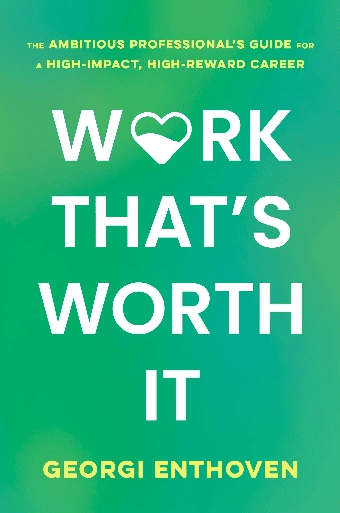
💚 Ready to begin transforming your career today? Start with Georgi’s bestselling book “Work That’s Worth It” – grab your FREE preview or BUY the full book today!
💚 Connect with Georgi Enthoven on Instagram (instagram.com/georgienthoven); LinkedIn (linkedin.com/company/georgienthoven)
Facebook (facebook.com/georgienthoven)
Website: www.georgienthoven.com
Transcription
Alyssa: [00:00:00] Plastic is completely over-engineered. These kinds of materials are engineered to the point where they persist in our environment for centuries, not thousands of years, never really fully breaking down, but I think the average plastic bag lifespan is something like 12 seconds if you’re thinking about, you know, a wrapper in a grocery store.
So how can you be engineering just enough? For this product to actually match what it’s intended for.
Georgi: Did you know the average person will work 90,000 hours in their lifetime? What if you could use those hours to find fulfillment and become a disruptor for good? Welcome to the Work That’s Worth It.
Podcast. I’m Georgi Enthoven, and I’m here to demonstrate that an ambitious, meaningful, and rewarding career is not just a dream. It’s achievable. Each episode we’ll dive into conversations with global change makers who crack the code on com. Binding income and impact. If [00:01:00] you’ve ever felt like you were torn between a paycheck and your purpose, or maybe you simply yearn for more purpose, you’re going to be exposed to the ambitious humans who have done it themselves ready to make your work worth it.
Let’s get started
doing good and having an impact. That’s something all of you listening care about, but making it work for you. That’s the challenge. My goal with this podcast is to shine the light on wonderful humans doing important work in the world. Sometimes we explore having impact within large organizations like my episode with Nishant Roy at Chobani, which is episode 41.
Other times it’s the entrepreneurial life that lights you up. Today we’re going inside an ambitious startup focusing on disrupting the $500 billion industry known as the plastic industry. Alyssa Pace is head of marketing and communications at Sway The Future, a [00:02:00] California based startup creating seaweed based compostable replacements for plastic packaging before sway.
Alyssa worked with mission-driven organizations like Planned Parenthood and Regenerative Organic Alliance. She studied environmental studies and multimedia writing at uc, Santa Barbara, and she’s proof that generalists thrive in climate startups. If you’ve wondered what startup life really looks like, how to avoid burnout in mission-driven work, or how does Spot greenwashing this episode is for you?
Let’s dive in. Alyssa, lovely to have you on the work that’s worth it. Podcast. Thank you for coming. Hi, Georgie. It’s great to be here. Thanks for having me. I want to get straight to the heart of the matter, and I want to know in your definition or your words, what is the problem that you are solving for in your work that you’re doing today?
Alyssa: That’s a great question. Let’s start on that. The work that I’m currently [00:03:00] solving for is applying regeneration to every step of the business value chain. So what that looks like for me today is I’m working with a company called Sway, that’s a material science startup based in the California Bay Area that’s creating replacements for plastics as we know them today, with solutions that integrate as much seaweed as possible and decompose in your backyard compost after they’re done.
And what this looks like for us is regeneration. How we’re sourcing ingredients, regeneration in the farmers that we are sourcing from, the manufacturers that we’re working with, and the brands that are then using the materials out in the world. And at the end of that material’s life, it can compost back into the soil returning nutrients.
So that’s on a very macro level of the mission that we’re trying to accomplish, but that’s a good starting place for the problem that we’re trying to solve.
Georgi: So, I mean, we all know we have a plastic problem [00:04:00] and you guys are innovating and creating a solution or an alternative to using plastics.
Alyssa: Sway is trying to solve for the plastics that are just absolutely everywhere in our daily lives.
There are these flexible film plastics that are everywhere when you’re at the grocery store, when you’re opening up your dog’s pouch of kibble, when you are receiving an e-commerce order to your doorstep. It’s just everywhere. And we all know that this plastic is wreaking havoc on every single aspect of everything that we can imagine.
And the environment from oceans to mountaintops and everywhere in between, there’s microplastics in the air, there’s pollution everywhere, and then this is all resulting in such. Economic impact as well. There is an unthinkable amount of money that’s going into the prevention or the cleanup of these plastics in our environment.
So how can we get to the root? Of this plastic problem and rethink what materials [00:05:00] that are in our everyday lives can be. And that’s where we see seaweed coming in as this amazing ingredient that can do so much good along the way, regenerating ocean ecosystems, creating more resilient and livelihoods for coastal communities, and offering a new path forward in a way that other ingredients that are used in compostable materials today like corn and sugar cane and potatoes, can’t do.
Georgi: Okay. Well this sounds like very inspiring work. Like you must get excited to get to work.
Alyssa: It is exciting. It’s exciting and it’s a huge challenge. I think that something that’s been a great theme across my career and I’m 30, so I’ve been in this space for about eight years working on all kinds of different projects, and I’ve been with Sway full-time for three of those years in total for two of those years.
But I’ve always ended up in these really exciting projects that are kind of pushing the boundaries on what we know and the environmental, or like the concept of environmental work that exists today. These regenerative concepts, these [00:06:00] beyond sustainable concepts. And it’s really exciting. But at the same time.
It is a bit of a wild west. Yeah. The space of material science is like the seaweed material space is fairly new, at least in terms of commercialization. You can look back on one of your O Chem textbooks from college and see, oh, seaweed has polysaccharides. That provide these different kinds of performance qualities that polymers traditionally used for plastics can do.
But this is really the first time that we’re seeing these kinds of materials grow at scale. So it’s really every day that we are working, there’s something new that’s happening and we’re really and truly always learning.
Georgi: So working on the forefront of change is exciting to
Alyssa: you. It’s definitely exciting.
It’s definitely challenging. Challenging, and there’s always something that you’re going to be learning. So if anyone’s listening and you’re like, I love a challenge and I love to be constantly trying to troubleshoot and figure out the best way forward, then this is a really great space to be in.
Georgi: Yeah.
What is your particular role at Sway? [00:07:00]
Alyssa: I’m the head of marketing and communications at Sway, so I am the one who’s leading all of the language that we’re bringing forward to the communities, working with the customers who are using sway materials in their packaging, how do they communicate this to their customer?
And then also more broadly, just trying to draw more people into the movement that we are creating. So managing our, our website, our social media, our newsletter, all these public facing assets where we get to talk about the work that we do. Use that as an invitation for anyone who’s interested in biomaterials.
Georgi: Now you have mentioned that you have spent your career so far doing mission-driven work. Can you talk about other experiences you’ve had just briefly to get you to this, this place at Sway?
Alyssa: Sure. Yeah. I’ll start actually with where I went to school because I think that’s a big part of it. Sure. I live in California and I went to uc, Santa Barbara, and it’s a wonderful school for anyone who is interested in the environment and climate solutions.
Santa Barbara’s home of Earth Day, that was. A [00:08:00] day of recognition that really originated here after the 1969 Santa Barbara Oil spill. So that started the celebration where we look back and look forward towards solutions every Earth Day since. So that definitely resonates at UCSB and I started out as a sociology major.
I was really interested in healthy communities at every level, and I was particularly interested. Food systems and food equity. And over time I realized that there’s so much connection between food and the environment that I ultimately ended up veering into the environmental studies degree. And I’ve always been creative.
I’ve always loved writing. I’ve always loved media, and so I tacked on a writing minor to that degree. And there was a multimedia writing emphasis or like focus that you could do within the writing minor, and I ended up going with that and it was amazing. That’s where I learned how to work in Photoshop, how I learned to set up a website, how to run a [00:09:00] blog, and that’s actually what landed me at my first career, just through an internship.
It was with a local marketing agency that focused on social and environmental good. Projects. So I went from being an intern there during my senior year into full-time right after I graduated, and then I was with them all the way up until transitioning to Sway full-time. But it was through working at this marketing agency that I got to work with so many different clients spanning the entire environmental world and beyond environmental too.
I got to work with the Regenerative Organic Alliance. Who does the regenerative organic certification? I got to work with the California Native Plant Society, planned Parenthood, natural Skincare Brands, all kinds of these different organizations and companies who spanned from product companies to government agencies to startups, and I really got to see so many different ways of working and how so many teams operate.
Georgi: [00:10:00] Now, were you always aligned or wanting to be aligned with your values and the work that you’re doing day to day?
Alyssa: Yes. I think that was always a non-negotiable for me. I grew up in Berkeley, so about five hours north of Santa Barbara and. I would say that values are pretty embedded into everything that’s coursing through Berkeley, and that definitely included education.
I think there was always a strong emphasis around how you as an individual can make a difference in this world. That was very much perpetuated by my family. Very nature oriented parents who tried to get me and my brother out in the outdoors whenever they possibly could. That was our version of entertainment, spending free time, vacations, and I just kind of always felt like going into a career that’s gonna be so much of my life.
What am I going to do? How do I wanna spend my time? And I’m so glad that I had that perspective since being young because as I have gotten through my twenties and now into my thirties, it’s your job [00:11:00] is so much of your time.
Georgi: And I talk about with work that’s worth it. It’s like 90,000 hours of your time.
Alyssa: Oh my gosh. That’s a crazy statistic.
Georgi: I know. And nobody tells you. And it’s a third of your adult life. And to have to show up at work instead of. Disassociate because of the work you’re doing. That’s a long time to be doing that. So I love that you naturally know what you’re interested in and that you have found these opportunities where you can work and feel aligned in the work that you do.
Alyssa: Yeah, thank you. It’s a blessing. It really is a blessing and I think that it’s something that anyone can, if they choose to do so. Work into that kind of space where they feel alignment between their values and the way that they’re spending their days for their career.
Georgi: I would love if you can explain to me and the audience about a circular business model.
Like what does that actually mean and how has that come into play with Sway?
Alyssa: Yeah, so circularity very broadly is re-imagining what our [00:12:00] systems can look like from being what is classically known as the. Take make waste linear equation and rethinking that into how it can be more circular. How can we source ingredients from the earth, get them into the most appropriate products.
And then after that use is through how can they provide some kind of return to the ecosystem, or how can they be revived into a new product. So sometimes that can look like recycling. In the case of sway, in particular, we’re looking at composting. So how can these materials that are made with regenerative and renewable and certified compostable ingredients break down safely after their use is through?
There’s a crazy stat that plastic is completely over-engineered. These kinds of materials are engineered to the point where they persist in our environment for centuries. Not thousands of years, never really fully breaking [00:13:00] down, but I think the average plastic bag lifespan is something like 12 seconds If you’re thinking about, you know, a wrapper in a grocery store.
So how can you be engineering just enough for this product to actually match what it’s intended for? In particular Sway loves to pay attention to the Ellen MacArthur Foundation’s circular Economy principles, which are prevent waste, circulate materials, and regenerate nature. And we really strive to fall into that third category of regenerating nature, which is why we look to sea, we.
Georgi: This model seems like a win, win win. It’s a win for you. It’s a win for the company that’s using your product, and it’s a win for the consumer. But does everybody on along that chain understand the benefits or do they see the value in that, or is that still a lot of the educating that you have to do
Alyssa: Both.
I would say that we have a lot of people who are attracted to Sway because they can see very clearly. [00:14:00] This makes so much sense. Of course, we should be moving forward in this way. Of course, we can’t continue to just degenerate and extract from the earth. We’ve gotta be given a little bit back, whether that’s keeping materials in use or allowing them to just return safely back into Earth.
Everyone in the environmental world does tend to get caught in their kind of echo chambers of We think this, and then you’ve got people who say yes, but you’ve gotta break outside of that too. You’ve got, I think that the real win for sway is going to be when we can share this kind of ideology or this kind of philosophy.
And you have someone who’s never even thought about this. Say, yeah, that makes sense. And then start to dig a little more. So we’re trying to get better at tracking how those journeys are actually happening. Because I hope, I imagine that they are from Sways side. That all to say, I think that there’s still a lot more education that needs to be happening, and that’s both with communities that we’re interacting with on a daily [00:15:00] basis that applies.
We know I’m in the us. That applies on a countrywide level. And then that also applies on a global level. That makes a lot of
Georgi: sense. You are working in a very entrepreneurial environment. I was wondering if you can share what’s an entrepreneurial reality of working in a startup like you do day to day?
What kind of people do well? What kind of pace are you working at?
Alyssa: Being a seed stage 10 person startup, everything is moving fast, very, very fast. On our team, I would say that we’re typically one or two person departments and then we have r and d, which is bigger. It’s a whopping five people maybe, ’cause they’re the ones who are actually doing the science and making the products.
We’ve got our sourcing our supply product. Communications along with the r and d, so it’s very fast. I think that something particular to my job that is critical in [00:16:00] making sure that everything can operate smoothly on a day-to-day basis is just making sure that our internal communications are completely efficient and completely smooth happening in the lab.
RD has gotta be translating that to supply. It’s gotta be translated to product. And product’s gotta be telling me on the comm side what’s happening. So I can only imagine what this looks like at a company that’s 500 people or 5,000 people. But definitely even within a team of 10, everything’s bouncing around constantly.
Georgi: So you’re wearing a lot of hats and probably covering a lot of territory on your day of the different tasks that you do.
Alyssa: Very much so, which is also really fun. Yeah. You get to build a lot of skills when there’s something to be done and it’s like, oh, who’s gonna do that? And maybe it’s not something that’s within your job scope as written down in your contract, but you’re [00:17:00] always expanding, right?
You’re always, always aiming to learn new things and figure out how we can bring our skills to the table when it comes to the health of the company.
Georgi: I am thinking about storytelling as part of the work that you do, both you in comms and also having a product that requires education and probably given what you’ve shared about your major and writing, how important is storytelling to you and what have you learned through the work that you’ve done to be able to use that skill?
Alyssa: I may be biased, but I do think that storytelling is everything. I think that how communication is presented is everything, and what I just mentioned about that internal communication being such a central point of the day-to-day is that it doesn’t matter if you’re the head of marketing and communications.
It doesn’t matter if you’re the head of r and d. It doesn’t matter if you’re an intern serving every single department at your startup, the way that you are communicating and bringing information forward. [00:18:00] As clearly. And as compellingly as you can do that, the better it’s going to be received. So that’s how I’m seeing the internal team communication happening.
And then I think that can also be very much applied to how storytelling is done sway to the public. We’re dealing with material science and these topics can be so complex and so nuanced. And as I also mentioned in the beginning of our podcast today, it’s kind of like the Wild West. So. These narratives that you’re bringing forward have to be given out bit by bit.
I like to use the, like a cookie crumbing analogy here is you gotta just, you know, you give them a little crumb, you can’t give them the entire story, just the, just the first page. See if they bite. Then you’re getting into the first chapter. If you’re still going, maybe you’re getting into the third chapter.
So I think that there’s a really strategic layering in storytelling that can happen. And then also when it comes to [00:19:00] material science, typically this isn’t the sexiest industry you’re dealing with a lot of. Candidly ugly prototypes or prototypes that aren’t performing well. And you know, it’s all about how you are presenting those to the world, how you’re presenting growth, how you’re presenting the possibility of these materials.
So really storytelling is everything. And when, and also I would add that when you’re looking at one material. One sheet of a sway swatch. You’re seeing a material that, yeah, maybe that material could replace your candy bar, but think a little bit bigger. What’s inside of it and what kind of impact can that have?
And as in progress as our materials are one day we hope. If these materials are scaling, it means that every wrapper you’re encountering that’s made by sway can also be rejuvenating ocean ecosystems and creating resilience in those coastal economies, and generally just driving down pollution and [00:20:00] increasing compostable practices.
Georgi: I am thinking about, you mentioned the word impact and how does somebody young or early in their career that wants to work in a mission oriented environment, how do they know that their, the company’s stated values are actually the values, so that it’s not greenwashing, or what tools would you recommend, or what questions would you be asking?
Alyssa: That’s a great question. One, do your research. Too many times I have been in interview settings where it’s very clear that someone hasn’t actually done their research to really understand the company and what they do and how they operate. So I would say that actually goes both ways. You know, as you’re investigating a company and as a company is evaluating you too, do your research look for how they back up the information that they’re sharing.
See who they collaborate with and what kind of relationships they hold for sway. Partnerships are everything and our work is guided. [00:21:00] So heavily by the partners that we keep around us, the material scientists who are on the cutting edge of other work, our peers who are in the startup space, folks who have been in plastic research and ocean health for decades.
Plastic manufacturers who have been doing this work for generations and know this space better than anyone. I think collaborations are a huge one.
Georgi: That sounds like a really good window into figuring out who you’re holding hands with. Who thrives at this kind of work that you do? The entrepreneurial work and sustainability, bringing a new product, disrupting an industry.
What kind of people thrive in this kind of work?
Alyssa: I think that there’s two answers to that, which is one, the people that are so committed, so beyond committed to the cause that their passion will carry them through whatever the highest peaks, but also the lowest valleys that you will. Inevitably face as a startup, [00:22:00] sometimes you’re going to have milestones and wins that were completely unexpected and they’re so worth celebrating.
But you also have to have that passion and the belief that can get you through the times that are a bit tougher. And I would also say generalists tend to actually really thrive in startups. When you can juggle a million things and grow in a million areas and you have that gusto behind you to drive you through, it’s a really powerful combination.
As I was saying before too, there’s always a million things that are getting thrown at startups in your day to day. So. Generalists can really thrive, and I would consider myself a generalist who started out in this space of really just wanting to help the earth, help people, and that brought me into environmentalism.
And then not by chance, but somewhat by chance, I ended up in this marketing agency and I had no idea what that was, but that’s what allowed me to kind of shape a path in marketing and [00:23:00] communications and move forward into this position.
Georgi: Yeah, so it sounds like really being committed to the higher mission and being willing to roll up your sleeves and do what needs to be done versus live by sort of a, a set of bullet points, which your job description is defined by.
Alyssa: Definitely. But the other piece that I would add to that too is generalists can thrive, but also if you have a talent or a specific skillset, lean into that as well, because anyone, whether you are a teacher, a lawyer, an artist’s. Whatever, you have something to contribute to the climate movement, and it doesn’t mean that you have to change your nine to five entirely to start working at a, an environmental startup or whatever.
It means that there are always ways that you can contribute your skills or your knowledge or your way of sharing with your community to this space. Sounds like
Georgi: what they say. All jobs are environmental jobs.
Alyssa: It doesn’t matter what you’re doing. I could not agree more. Yes,
Georgi: [00:24:00] I wanted to talk to you about burnout.
I talk with a lot of young, early professionals, ambitious professionals, and burnout seems to be a topic that comes out again and again. How do you avoid burnout?
Alyssa: I have surely experienced burnout. I can say that and I, I hope that it’s not something that people feel that they have to shy away from in speaking about their work experience.
I think that the time that we exist in everything is turned up to level a hundred when it comes to. Productivity and efficiency and just being the best. So it doesn’t surprise me that a lot of the people that you talk to are experiencing or have experienced some form of burnout. I would say that I was probably experienced a, a pit of burnout about a year ago, and for everyone listening in right now, I also work from home, which makes it very hard to detach from work sometimes when your [00:25:00] office is.
Accessible at any point in time, and we also have all of our messaging apps and our email on our phone. Everything is too accessible, so what I say is, make yourself less accessible, figure out your hours and stick to those boundaries. Know when you can say no. Understand what on your task list is actually a priority.
I love setting like a P one through three with my manager, who’s our CEO at the top of the week. Just to know this is really important and this is gotta be completed this week. Or you know what? That thing that we talked about a couple weeks ago, let it go. It doesn’t have to be on your task list. It’s actually not that important.
I recently became a manager of a direct report this year, and I think it’s such a valuable lesson for everyone to, to move into a manager role, to understand like one, there can be less pressure on you. I realize looking [00:26:00] at her, I’m like, I don’t wanna overburden her. I don’t want her to feel that burnout.
And so I try to be mindful in how I’m presenting information to her and I’m trying to teach these lessons to her actively as well as she is getting deeper into the work.
Georgi: I love that. So boundaries for yourself, which makes a lot of sense. And especially working from home, prioritizing, which also makes a lot of sense.
So you know what you have to get done that week.
Alyssa: Mm-hmm.
Georgi: And then I love this idea of. You being kind to yourself by saying, I need to detach, but also kind to your employee or if you have a boss, is that boss gonna be thinking about you in that same kind way of we do need to replenish ourselves. And I often think about the work that I do is.
I want people like you to be able to last their 90,000 hours because we need kind good hearted people working and getting into C-suites and boardrooms and investing and all the rest, and so that is not gonna [00:27:00] take place. If the kindest people are burning out,
Alyssa: echo that.
Georgi: Yeah. I love that you are already thinking about it and building in systems to help you navigate that.
Alyssa: Yeah. Build the systems before it starts happening, because once you’re in too deep, it’s too late.
Georgi: Yeah. The last
Alyssa: piece that I would add onto this too is be kind to yourself. Be kind to the people that you work directly with, and then as a team, celebrate everything. Celebrate everything far beyond what the celebration warrants.
Anytime a milestone happens, I think it’s very easy to think, oh, okay, that’s, that was something that we were planning for and we don’t, you know, that was just expected. No. Your perspective should be to celebrate every single win. I think especially right now when so many people are feeling burnout when there’s been.
No more urgent time to do everything that you can for the planet and the health of the people around the globe. You gotta take every win as a win,
Georgi: [00:28:00] and I love that. This ties back to something you’ve said earlier, which is community being such an important part, and I imagine as you’re celebrating, it’s actually building community.
That’s what sort of bonds you and you get excited and spend time together celebrating your wins.
Alyssa: It’s beautiful. I love being able to spend time in person with our partners who I work really closely with, and even just being able to take snippets of news to our social media audiences or our newsletters, or be just like our close friend contact list and say, Hey, this happened and it is huge, and we would not be here without you, which we truly mean.
It’s huge to have them celebrate with you, and I think it perpetuates a little bit more joy and a little bit more hope into the movement and the work that we’re all doing.
Georgi: Yeah. Nothing wrong with having some fun.
Alyssa: Agreed.
Georgi: You had shared with me before we jumped on the call that you have some resources that you would recommend for young people looking to get into this kind of work.
What can you share with us?
Alyssa: Yeah, absolutely. [00:29:00] I do get a lot of inquiries from folks who are interested in supporting Sway, contributing in some way, and we’re not currently hiring, but I love pointing people to the job boards that I think are always posting the best jobs. If you haven’t heard of them already, I would definitely bookmark green job boards and climate base, both incredible sources for post of new jobs.
And then we also tend to look at the job boards that exist within. Investors and VCs that invest in environmental companies. So one great example would be Super Organism. They’re an amazing investor of Swayze and they have their own job board that’s available for anyone to peruse. I know that other VCs, like Third Sphere have similar kinds of platforms, so look to those spaces.
I think that’s always going to be a good one to check out, especially if you’re looking to get into tech or startups that are within the [00:30:00] environmental world. I
Georgi: love that advice and I have heard that from, I’ve interviewed some venture capitalists on the podcast in different categories from climate to focusing on women, and if you are interested in a particular category, to find the investors who are investing in those categories and seeing who the portfolio companies are and you know they have funding, and that is helpful if you are looking for some of that startup experience with a particular contribution in mind.
Exactly. Yeah. Well, it’s been so helpful to chat with you and learn more about Sway and it feels very exciting to have a glimpse into the work that you do. So thank you so much for sharing all the details and I really look forward to keeping in touch with you.
Alyssa: Thanks so much, Georgi. It means a lot.
Thanks for having me on, and thanks for helping us share the mission and for anyone who’s interested in the work we do, you’re welcome to check out Sway the Future on Social Media, or shoot an email to team@swaythefuture.com if you’re interested in any kind of [00:31:00] future work or collaboration.
Georgi: Yeah, and I will link those in the show note.
And yeah, have a lovely rest of the day. Thanks so much. Bye bye now for my Hot Takes. First, early on in your career, figure out if you are someone who thrives as a specialist. Or if you’re a natural generalist in early stage climate work, Alyssa shared. The people who thrive are those that can juggle a million things and aren’t precious about their job description.
Second, celebrate all the wins. I loved Alyssa’s reminder to look for reasons to celebrate together as a team, even the wins that feel expected when everything feels urgent. Because it is taking time to acknowledge progress isn’t indulgent. It’s a survival strategy. Third, your job is already a climate job.
You don’t need to quit your job and join an environmental startup to make an impact. Whether you’re a teacher, a lawyer, or an artist, you already have [00:32:00] skills The climate movement desperately needs. The question isn’t, should I change careers, but how can my existing skills contribute where I’m at? Lastly, greenwashing check.
Real impact companies surround themselves with examples of material scientists, decade long ocean health researchers and legacy manufacturers who know the space inside out green washers are likely to operate in isolation. And that’s a wrap for today’s episode of work That’s Worth It. Remember, every conversation we share is designed to empower you to build a career that’s truly worth your time and energy.
There are future disruptors out there just like you, who would appreciate the conversations in this podcast. Please support me by spreading the word and sharing this episode with a friend or two, or visit my website@georgie.com. That’s spelled. G-E-O-R-G-I-E-N-T-H-O-V-E n.com. [00:33:00] Until next time, ask yourself, what problems am I solving and are they worth my valuable time?
Your intentional choices today can lead to exponential impact tomorrow. Thanks for listening.


GET GEORGI'S BOOK
Meet Georgi Enthoven
As the visionary founder of Work That’s Worth It, Georgi specializes in unearthing the unique inspiration and career desires of those seeking significance both for themselves and for the world.