

About this episode
Have you noticed that everyone around you is concerned about their jobs and careers (not just young graduates by the way!)? Whether we blame AI, tariffs, or both, workers are scrambling to “AI-proof” their careers with tactical skills that might become obsolete tomorrow anyway. All this turbulence is very real.
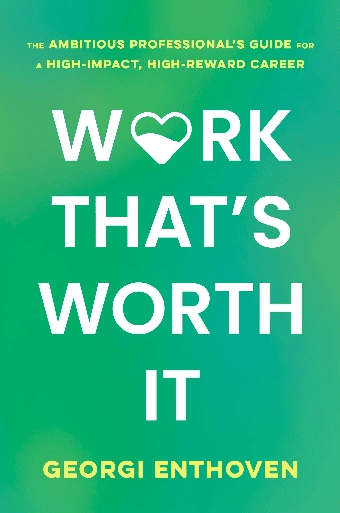
Ready to love your Mondays? Buy ‘Work That’s Worth It’ now – Amazon, B&N, Bookshop.org OR, need more convincing? Get the first chapters FREE here.
SHARE THIS EPISODE


03 Sept 2025
SEASON 1, EPISODE 39
Show Notes
I have a much more powerful strategy for thriving in today’s uncertain job market that I want to share with you in this episode. And yes, it involves zooming out and thinking about your 90,000 career hours, and how you would like to “spend” them. This episode reveals the career secret that transforms your career into a worthwhile and meaningful experience that makes you indispensable—regardless of what technology throws at you next.
Exercises:
I help [who] achieve [what] by [how] because [why]
Email Georgi to share details about your contribution: info@georgienthoven.com
Links Mentioned in Today’s Episode
World Economic Forum Global Risk Report – Outlines pressing global issues worth solving
Drawdown.org – Library of environmental solutions for planet-focused careers
Capital F Fund portfolio
Transcription
Georgi: [00:00:00] Welcome back to the Work That’s Worth It, podcast. This is the place that gets you excited and inspired to go to work by building a career that’s both good for you and good for the world. I’m your host, Georgi Enthoven. The New Yorker just posted a cartoon that perfectly captures what so many students and workers are feeling right now.
Georgi: Picture this. A mother is saying goodbye to her son heading off to college. And the tagline reads, follow your dreams ideally in a field that will still require humans when you graduate. Ouch, right, but also painfully accurate. So much is changing right now. Here’s what I see happening. Everyone’s throwing out short term career advice, how to AI proof your resume, how to bypass the resume bots, how to keep AI from taking over your job, et cetera.
Georgi: Perhaps useful short term, but these are like floaties that might keep you afloat for a little while, but they [00:01:00] won’t get you to solid ground, and they certainly won’t get you to a fulfilling place where you’re excited to wake up on Monday morning. Today I’m sharing a different approach, unique to work that’s worth it.
Georgi: One that doesn’t just help you survive the challenging job market, but actually thrive in it. This is a career secret that will set you apart from everyone else scrambling for safety. So grab a notebook or open your notes app because you are going to want to write some things down. For those new to the podcast, I’m Georgi Enthoven.
Georgi: I’ve lived on four continents, spent half my life in emerging markets, and now find myself in the epicenter of AI growth in San Francisco. I have over 20 years of work experience across every type of organization imaginable, including for-profit, social impact, and not-for-profit. I’m also the author of USA Today bestselling book work that’s Worth It.
Georgi: And I’ve coached hundreds of young professionals who want to build careers that combine meaningful contribution with compensation to match their [00:02:00] ambition. Here’s what I’ve learned. Today’s work environment between AI encroaching on jobs and uncertain policy changes on tariffs has everyone, not just young people looking for safety.
Georgi: But the turbulence in the corporate world has hit early career professionals particularly hard. And while everyone’s focused on tactical skills that might become obsolete tomorrow, there’s a much more powerful strategy that I want you to consider. The question isn’t what skills should I develop so that I can survive?
Georgi: But rather ask yourself, what local or world problem do I want to solve or become an expert on? That’s the big idea. Think about it this way. Even if you’re the very best programmer in a particular coding language today, you can assume that you will keep having to relearn the latest tools to keep relevant, and is that really what you want to be known for anyway?
Georgi: Does that make your 90,000 hours worth it? Or would you rather be known as an [00:03:00] expert who solves an important problem in the world? Let me give you some examples from guests on this podcast. Evan Jones became the go-to expert on getting South African youth into technology opportunities that would otherwise be outsourced.
Georgi: Debbie Sterling made herself the authority on exposing girls to STEM fields. These aren’t just jobs, these are personal missions that create their own demand. When you wrap your career around solving a real problem, something magical happens. You stop competing with everybody else for the same generic positions, and instead you create your own category.
Georgi: You become irreplaceable. Not because of what you can do, but because of what you care about and the experience you have. Solving something important to you. This is what I call finding your contribution, your personal mission in the world. So for beginners, I have a one word strategy. If this concept is new to you, let’s start [00:04:00] simple.
Georgi: What one word, or at most two words that could anchor your entire career. Something that gets you into a world of like-minded people who care about the same things you do. This might come from something painful you’ve experienced directly, such as focusing your career on childhood cancer after losing a sibling, or it might come from your unique perspective and life experiences.
Georgi: Like a previous podcast guest of mine, Daniel Lane, a doctor who started a fertility and reproductive health center focusing on sperm and egg donations for underrepresented groups. Right now, pause this podcast and write down one or two words. Don’t overthink it. What gets your heart racing? When you read the news?
Georgi: What makes you think someone should really do something about this? Great. Now that you’ve written that down, or at least thought about it, if you’re driving, if you’re feeling stuck, here’s my go-to strategy. Focus on problems in your community or [00:05:00] the world worth solving. In my book, I reference resources like the World Economic Forums Global Risk Report, which you can look up which outlines many of the most pressing issues today.
Georgi: But if you already have a sense of your area of interest, dig deeper. If it’s helping our planet, explore draw down.org for a library of environmental solutions. If it’s social justice, dive into specific research on that topic. You get the idea. The key is to pick one or two problems and really understand them.
Georgi: Read about them. Find out which companies not-for-profits and governments are trying to solve them. Could it be access to clean water? Create lasting peace. Ensuring equitable education, delivering unbiased news. Remember, you’re going to spend 90,000 hours of your life working. You’ll never regret spending that time contributing to a problem worth solving.
Georgi: If you already have a grip on the problem you want to solve, [00:06:00] let’s get it into words that make it easy for other people to remember and repeat. Because here’s the thing, if you can clearly articulate what you’re here to do with your 90,000 hours, others can easily repeat it too, and they will bring you into conversations every time your area of expertise comes up, even if you’re not in the room.
Georgi: I have two helpful ways for you to consider getting your personal mission into words. Check the show notes when you’re ready to fill in the blanks, but for now, I’ll walk you through it verbally, which is a little bit awkward to do on a podcast, but here goes fill in the blanks. I help X, that’s who you helping achieve X, which is what you’re helping them achieve by X, which is how you’re helping them achieve it.
Georgi: Because X, which is Y, it matters to you. That’s the first one. The second way to do it, which I have [00:07:00] seen, especially from many of the people that I interviewed for my book and have talked to on my podcast, is a framework for those ready to make a pretty bold declaration. Amy King, who I featured on this podcast and is in my book, said, I want to end homelessness in my generation, Sammy Kinnan declared I want to reverse diabetes and obesity in a billion people.
Georgi: Imagine the clarity and focus that gives you, it’s immediately clear what to say yes to and what to say no to. People rally behind declarations like these. Great. So now either you have your one or two words or your personal mission statement. Now, how do you make your contribution real or tangible in the work world?
Georgi: If you are already employed, start bringing your mission into the work you’re doing right now. Want to help companies achieve net zero? Start with your current company. As I like to say, all jobs are environmental jobs. You don’t have to be in a climate lab with a lab coat on [00:08:00] to help improve our environment.
Georgi: Same with helping people. All jobs are people, businesses. Think about how you can have an immediate impact and build the roots of your expertise right where you are now. Sooner or later, you’ll become the person in your company known for caring about and understanding your chosen problem. So what if you need a job?
Georgi: It’s true. It’s hard to search job boards by problems they solve, but with today’s AI and research tools, it doesn’t take long to identify the people to watch in your area. Start networking with 15 minute zoom calls. Use your college network to make connections. As Jessica Lindel points out in her book, the Career Game Loop, it’s the loose ties that get you the jobs.
Georgi: People who know people according to LinkedIn’s research. These loose connections are actually more helpful than your closest relationships. Here’s a pro tip from venture capitalist Dawn Doris. Look at the portfolio companies of [00:09:00] VCs focused on your area of interest. If you care about improving women’s lives, check out her Capital F Fund portfolio.
Georgi: Each company is working on that exact problem. Here’s something important, going into an interview and saying, I’m passionate about democratizing. Education isn’t enough to get you hired at Khan Academy. You need relevant skills too, and if you’re just starting out with minimal hard skills, your selling points are your willingness to learn, your great attitude, and the time you can dedicate to mastering what’s needed.
Georgi: Companies need people who genuinely care about their mission and underline and can contribute to achieving it. Here’s what I want you to remember. You will never regret the time you spend solving a real world problem, never. While everyone else is frantically trying to skill proof themselves against automation, you’ll be building expertise around problems that are becoming more [00:10:00] urgent, not less relevant.
Georgi: You may find yourself creating your own demand instead of competing for someone else’s job. What’s next? I wanna hear from you. Email me at info@georgienthoven.com and share your thoughts about your area of contribution, which is also in the show notes in case you’re driving, I’ll give you my feedback and any resources I can share.
Georgi: This stuff genuinely lights me up, so don’t be shy. Remember, all you need to get started to decide on is one umbrella. Word that opens a portal to your future. No excuses. Before I sign off, I need your help. If this episode was valuable to you, who else could benefit from getting out of the weeds of their job search or next career move?
Georgi: Please share this episode with them. Now off you go into the wild and unleash your magic. I can’t wait to see what problem you choose to solve, but more importantly, why it matters to you. Thanks for listening to work. That’s worth it. Until next time, make those 90,000 [00:11:00] hours count.


GET GEORGI'S BOOK
Meet Georgi Enthoven
As the visionary founder of Work That’s Worth It, Georgi specializes in unearthing the unique inspiration and career desires of those seeking significance both for themselves and for the world.